

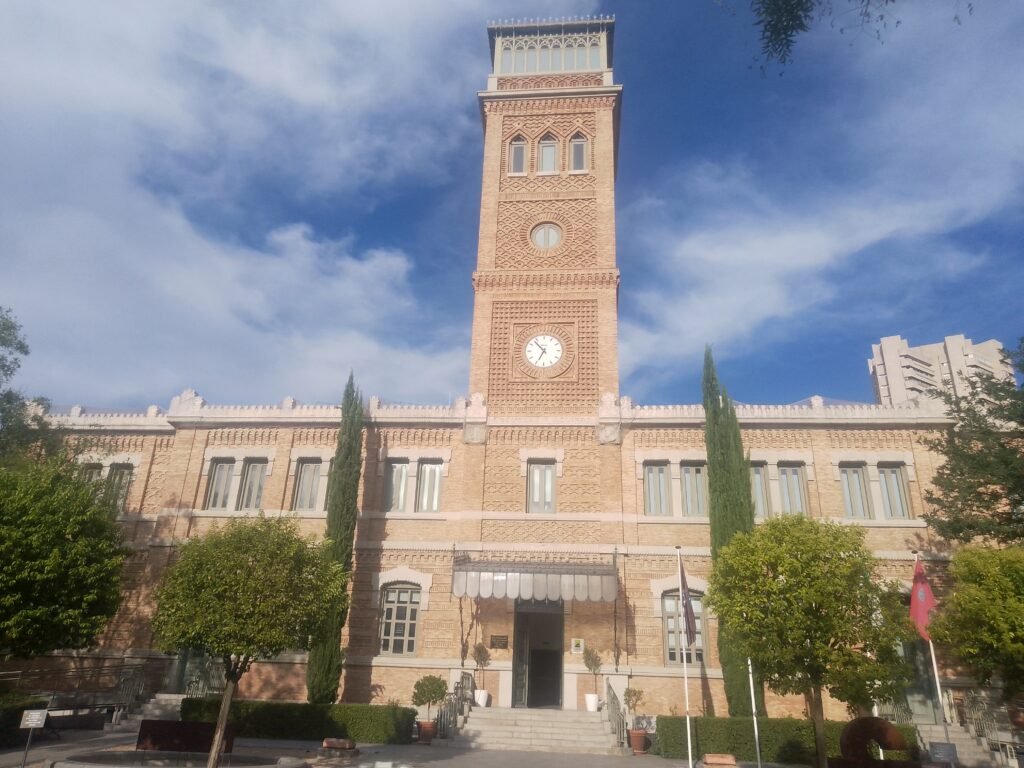
Yesterday Casa Árabe´s 20 year stay at Escuelas Aguirre, a beautiful 19th century Neo-Mudéjar building that sits across from Retiro, came to an end. With the City Council of Madrid giving Casa Árabe notice to leave the premises and the PP Mayor Almeida going as far to say that they are now illegally occupying the building.
But what is Casa Árabe ? It has been a cultural and educational institution for Arabic culture, hosting exhibitions , workshops , civic receptions and of course an Arabic language school. Although a Casa Árabe in Cordoba still remains, the one in Madrid (Spain´s political and cultural capital) is under threat.
As protestors gathered last night over the closure of the institution, we spoke to Sagrario on behalf of protest group “Casa Árabe no se toca” on the importance of maintaining this cultural space and what the future holds.
“This is only a political fight”
“We can´t understand the ultimatum from the council to Casa Árabe .” explains Sagrario. “They have said there are some problems with the building but also that this institution was a chiringuito, which means it is an institution which is empty of purpose and its value is zero. We fully disagree with this interpretation.”
Sagrario also draws attention to the political aspect of the decision. “We consider that this is only a political fight between the council and the central government. We should remember that this institution is managed by a council of different administrations including the Council, Regional Government and Ministry of Foreign Affairs. So any problem that has to be faced should be in this scope.”
The reports today that the Ministry of Foreign Affairs has rejected the assertations of the city council as “false”, because no process of eviction can begin without the Governing Council (of which the city council is but one member), would strenthen Sagrario´s viewpoint. However, critics would retort that the previous management of Casa Árabe was by a former PSOE Congress member Irene Lozano and in her term the nearly one million euros annual losses as identified by the Tribunal De Cuentas is the cause of the institutions jeopardy.
“Cultural Insitutions like Casa Árabe have to be respected”
But between the political bunfight, their is a cultural institution at risk and its place at the heart of city , rather than shunted away to the periphery. This does say something about the type of culture a city wants and Sagrario thinks this central location is vital. “It´s crucial because the architecture is linked to the Arab heritage of Spain so this not a question that can be solved by just changing the venue.”
With more cultural institutions under pressure, including the now empty Cafe Central in Santa Catalina, what does Sagrario think is the consequence of this trend? “Absolutely it is going to have an impact because the cultural value we give to Madrid is huge. Of course Madrid has a lot of tourist areas but the cultural institutions have to be respected and supported because they are part of the personality of the city.”
“We (Casa Árabe) don´t have a clear plan for tomorrow”
So what is the plan now? “To be honest, we don´t have a clear plan for tomorrow. We were very hopeful to know what was the council thinking and we are disappointed for what we heard. We thought they were looking for a solution , or an intermediary. But from what we heard today, we have to organise ourselves and think about the next steps.”
Correction: We previously stated that Sagrario was speaking on behalf officially of Casa Árabe, not the protest group “Casa Árabe no se toca”. This has now been changed in the article.